


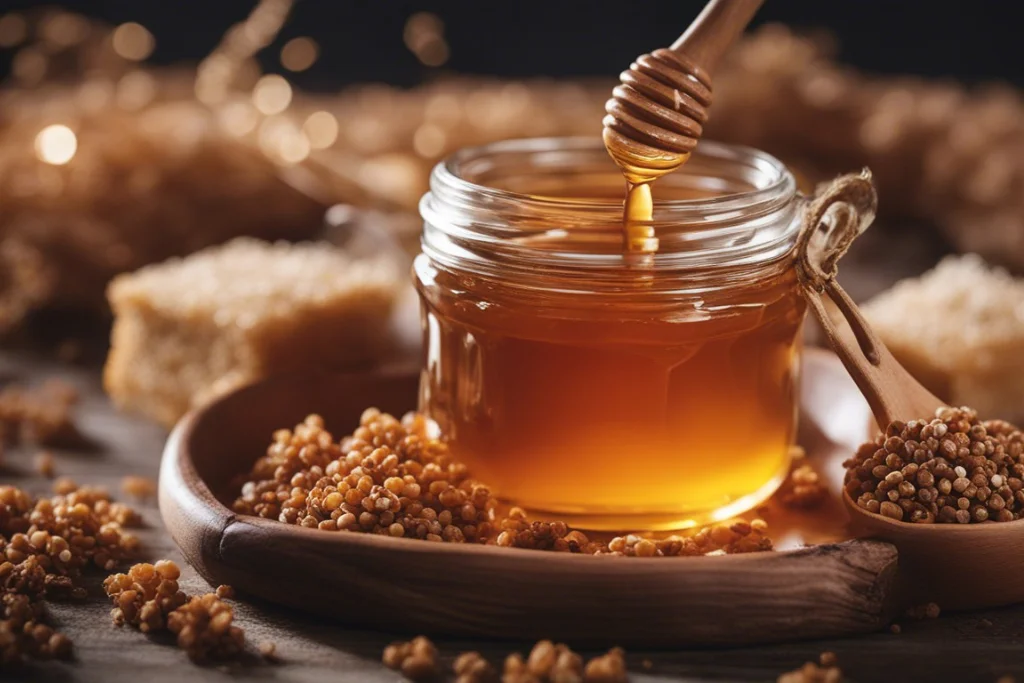
Honey does not always have the same taste, color or nutritional profile. The flowers visited by bees can strongly influence the final product. Buckwheat flowers produce a type of honey known for its dark color, strong flavor and rich plant compounds.
The taste is often described as earthy, malty or slightly molasses-like. Its darker appearance also makes it different from lighter varieties such as clover honey which usually has a milder flavor.
But what actually gives this honey its distinctive character? The answer involves its floral source, natural compounds, processing and growing conditions.
What Makes Its Flavor So Strong?
The flavor starts with the nectar from buckwheat flowers. Bees collect this nectar and transform it into honey through natural enzymatic processes and water reduction.
Buckwheat nectar contains plant compounds that contribute to the final taste and aroma. After ripening these compounds remain part of the honey’s complex chemical profile.
The result is usually a stronger flavor than many light-colored honeys. Some people notice earthy, nutty, malty or slightly bitter notes.
The exact taste is not identical in every jar. Geographic location, weather, flowering conditions, harvesting time and processing can all influence the final flavor.
Why Is This Honey So Dark?
Color is one of the easiest ways to distinguish this honey from many lighter varieties. It can range from deep amber to dark brown.
Research has found that darker honeys often contain higher concentrations of phenolic compounds and show stronger antioxidant activity. In comparisons of different floral honeys, buckwheat samples have repeatedly ranked among the darker and more antioxidant-rich varieties.
However dark color does not automatically mean that every dark honey has the same nutritional value. Floral source and geographic origin can change the chemical profile.
Compounds Behind Its Dark Color and Flavor
The strong flavor is not caused by one single compound. Honey contains a mixture of phenolic acids, flavonoids, sugars, organic acids, minerals, enzymes and other minor components.
Studies of buckwheat samples have identified compounds such as p-hydroxybenzoic acid, chlorogenic acid, p-coumaric acid, rutin and other phenolic substances. Their amounts can vary between samples.These compounds are also important when researchers examine antioxidant activity.
A 2025 metabolomics study found that several groups of compounds were associated with antioxidant activity in buckwheat honey. The researchers identified not only polyphenols but also organic acids, amino acids and other compounds that may contribute to its antioxidant profile.
Antioxidants Found in Buckwheat Honey
Antioxidant activity is one of the most researched properties of this honey.
In laboratory comparisons buckwheat samples have often shown high levels of total phenolic compounds and antioxidant activity. One study comparing six Polish honey varieties found the strongest antioxidant activity in it alongside the highest total phenolic and flavonoid concentrations among the tested varieties.
Another study found that darker honeys including it had higher antioxidant measurements than several lighter varieties. The researchers also found a relationship between color, phenolic content and antioxidant activity.
Must-Know Facts:These findings are useful but laboratory antioxidant tests should not be interpreted as proof that eating honey prevents disease.
What Does Human Research Show?
Human research is more limited than laboratory research but some interesting findings are available.
In one small study 25 healthy men consumed water containing buckwheat honey. Their serum antioxidant capacity measured by ORAC increased by about 7% after consumption. The study was short-term and involved a small group so it cannot establish long-term health effects.
Another human study found that consuming this honey increased plasma total phenolic content as well as antioxidants and reduced capacity in healthy adults.
Don’t Miss These Facts:These studies suggest that some compounds from honey can be absorbed and may influence antioxidant measurements in the body. They do not prove that the product can treat or prevent a specific disease.
Advantages:
The buckwheat honey benefits most strongly supported by current research relate to its antioxidant compounds and its potential role as a natural sweetener.
Its phenolic compounds can contribute to antioxidant activity while its carbohydrates provide a concentrated source of energy.
Must-Know Facts:Research has also examined antimicrobial properties. A 2018 study found antibacterial activity against Staphylococcus aureus and Pseudomonas aeruginosa that was comparable with the tested Manuka honey sample. However laboratory antibacterial activity should not be confused with proven treatment of infections in humans.
This distinction is important when reading health claims online.
Buckwheat Honey vs Manuka Honey
The comparison between buckwheat honey vs manuka honey is interesting because both are associated with bioactive compounds and antimicrobial research.
A 2018 laboratory study found that this honey had higher amounts of total phenols, sugars, and some minerals than the tested Manuka honey while Manuka had higher methylglyoxal levels. The buckwheat sample also showed higher cellular antioxidant activity in that study.
Key Points to Know:This does not mean one is universally better. Different products can vary by floral source, geography, harvest, processing and testing method.
Is It Helpful for Cough Relief?
Honey has been studied for short-term relief of cough symptoms. A systematic review found that honey may improve cough frequency and severity in people with upper respiratory infections although the quality of evidence varies.
This is where buckwheat honey for cough may attract attention. However most clinical evidence concerns honey generally rather than proving that this honey is superior to every other variety.
Key Points to Know:Honey should also never be given to babies under 12 months because of the risk of infant botulism.
Dark Honey vs Light Honey
Flavor is one of the biggest differences between dark and light varieties.
Orange blossom honey for example is generally known for a lighter floral and citrus-like character. Buckwheat honey is usually much stronger and more earthy.The difference is largely related to the plants from which bees collect nectar. Floral sources can influence color, aroma, phenolic content and antioxidant activity.
This is why honey should not be judged only by sweetness. Two varieties can have similar sugar content but very different sensory and chemical characteristics.
What Happens When Honey Is Heated?
Processing can influence honey’s composition. Heating, filtration, storage conditions and duration of storage can affect some enzymes and other compounds.
This is also why “raw” and “buckwheat” describe different things. Buckwheat refers mainly to the floral source while raw refers to how the honey has been handled.
A jar can therefore be honey without necessarily being raw.
When buying it check the label for origin, ingredients, processing information and producer details instead of relying only on the variety name.
What Causes Honey to Crystallize?
Crystallization is a natural process in honey and does not automatically mean that it has spoiled.The amount of glucose and fructose, water content, temperature and the presence of tiny particles can affect how quickly crystals develop.Because this variety contains a different balance of sugars and compounds from some lighter honeys its texture may change during storage.
Key Points to Know:Crystallized honey can still be used as long as it has been stored properly and shows no signs of spoilage.
Using Honey Without Excess Sugar
Although it contains naturally occurring compounds honey is still mainly a sugar-rich food.
A small amount can be added to oatmeal, plain yogurt, tea, toast, smoothies or homemade dressings. Its strong flavor means that you may need less of it than a mild honey to achieve the taste you want.
Key Points to Know:Using a small amount as a replacement for another added sweetener can be practical but it does not make a high-sugar meal automatically healthy.
How to Check Honey Quality
Quality can vary between products so the label matters.
Look for:
- Clear country or regional origin
- Transparent ingredient information
- Producer details
- Processing information when available
- Proper storage instructions
- Realistic product claims
Key Points to Know:Be cautious when a honey product promises to cure medical conditions or replace treatment. Research on honey is promising in some areas, but evidence does not support treating it as a medicine for every condition.
Sum up
The strong flavor of buckwheat honey comes from its floral source and complex mixture of natural compounds. Its dark color is also linked with a higher concentration of phenolic compounds in many tested samples.
Research has found strong antioxidant activity and interesting biochemical properties while small human studies suggest that consuming it can affect antioxidant measurements in the blood.
Still these findings should be viewed realistically. Honey is primarily a sweet food and laboratory results do not automatically translate into disease prevention or treatment.
For people who enjoy a deep, earthy flavor this variety offers a distinctive alternative to lighter honeys while providing naturally occurring plant compounds that continue to be studied.
Frequently Asked Questions
Is this honey healthier than regular honey?
It can contain higher levels of phenolic compounds and show stronger antioxidant activity than some lighter honeys. However its overall nutritional value varies by source and it is still a sugar-rich food.
Why does buckwheat honey taste bitter?
Its stronger earthy and slightly bitter taste is linked to its floral source and naturally occurring plant compounds. This gives it a more intense flavor than many light honeys.
Does this honey have more antioxidants?
Research has found high antioxidant activity in many buckwheat honey samples. However the exact level can vary according to floral source, geography and processing.
Can you use it every day?
It can be included in a balanced diet in moderate amounts. Because honey contains significant amounts of natural sugars, portion size still matters.
Is dark honey always better?
No. Dark color can be associated with higher phenolic content in some honeys but color alone cannot determine the overall quality or health value of a product.
